The problem
1 · Just give it to the AI
Imagine a data analyst whose job involves building and maintaining dashboards in their enterprise business intelligence (BI) tool.
Historically, the job of building a dashboard was much more than just creating fancy charts, as they needed to work with stakeholders to unpack their needs and build something of value. They would consult with the eventual users of the dashboard, listen to their needs and pain points, and design a dashboard that was fit for purpose.
But in recent months their company has invested heavily in AI. It recently launched a Model Context Protocol (MCP) server that connects its AI chatbot directly to the data warehouse. Now, business users can simply prompt the AI with "build me a product dashboard" and voilà. With just a few minutes of inference and less than $1 in API costs, the dashboard exists.
This has taken what would have been days to weeks of work and reduced it to minutes.
It's exciting, and the implications for drastically improving productivity are evident. But this raises important questions.
Is the data in the dashboard accurate? Are the metrics and charts relevant to stakeholder needs? Does it actually create value or answer key business questions?
The dashboard might look great, but is it just AI slop?
If you've taken a process that typically took days and reduced it to minutes with a single prompt, then the answer is almost certainly yes.
This is part of the challenge of working with AI. AI output almost always looks polished and convincing, which can make you feel more productive when, in fact, you might be less productive, creating content and artifacts that no one uses and that create no material value.
In your AI-generated dashboard, which numbers matter? What decision should it support? Who will use it, and what actions should they be able to take afterwards?
None of that was in the prompt.
The AI had enough direction to produce something that looked like a dashboard. It didn't have enough to know which dashboard you and your stakeholders actually needed.
That is the problem with judging the result by how it looks. A chart can be beautifully presented and measure the wrong thing. A number can be correct and irrelevant to the decision. The dashboard can look ready long before anyone has checked whether it is useful.
What you handed over
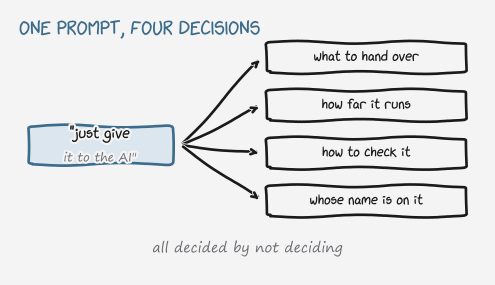
Consider what those five words, build me a product dashboard, actually handed to the AI. The prompt didn't say what the dashboard was for, so the AI decided what it should contain, and it reached for the metrics that appear on most product dashboards: active users, revenue by plan, a retention curve.
Nothing in the prompt asked to see an outline or proposal, so it went straight from the request to a finished dashboard. Along the way it chose which tables to pull from the warehouse and how to define an "active" user, and nobody saw either decision. Nobody had said what "good enough" would look like, either, which left a glance at the result as the only check. And if the dashboard gets forwarded to the leadership team, whoever sends it is putting their name to definitions and choices they never saw.
That adds up to four decisions: what to hand over, how far to let the AI run before you look, how you'll check the result, and whether you're prepared to own the outcome and put your name to it.
These are the four dimensions we covered earlier applied to a single prompt: understand AI before you hand over the work, work with AI while it runs, evaluate AI once it produces something, and own AI risk across the whole process. A short prompt doesn't make those decisions disappear; it forces the AI to fill in gaps and make key decisions for you, and you only find out which ones when you review the result.
We call this habit prompt and pray: you type an instruction and hope it works. When a polished result comes back, it turns into prompt and awe: the output looks good, so you assume it is good. Both treat the first response as the end of the job, when the most important decisions haven't been made yet.
Much of the AI training available today stops at exactly this point. It teaches people how to write a prompt and shows them impressive results, which makes a polished response feel like the finish line. But a demonstration of what a tool can produce tells you very little about what you should let it decide.
Part of the problem is that none of this feels like delegation. You type a sentence and press enter, which feels about as weighty as running a Google search. It's far too easy to phone in the task of delegating tasks to AI. And it helps to think about what you would normally do before handing such work to someone, or something, else.
If it were a junior colleague
Say you'd given the same dashboard to an analyst who joined your team last month. You wouldn't just say "build me a product dashboard" and walk away. You'd explain who it was for and which decisions it should support, and point them to the tables the data should come from. You might ask for a rough sketch of the layout before they spent a day building the whole thing.
You'd also warn them where mistakes tend to creep in: a metric whose name doesn't match what it measures, a calculation that only works with the right filter applied, or a comparison that makes sense only over the right time period. And before the dashboard went to anyone else, you'd review it yourself. Your colleague did the build, but you're the one who has to answer for it.
Those habits are just as valuable with AI. The catch is that AI doesn't always give you the signals that remind you to use them. A new analyst might ask what "active user" means, show you a half-finished draft, or admit they're stuck, and any of those would prompt you to step in. AI can ask clarifying questions too, but you can't count on it to ask the ones that matter. It's just as likely to make an assumption, carry on, and hand you something that looks complete. That's why you can't judge how much supervision it needs from how confident it sounds: a polished answer looks the same whether the AI understood the task or guessed.
Some of the work is still yours
Briefing someone properly has a second benefit: it forces you to decide which parts of the job you're actually handing over. A dashboard is several tasks bundled together, and so is a report, a presentation, or a recommendation. When you put the whole job into one prompt, it's easy to lose sight of how different those tasks are.
Say the finished dashboard shows that trial-to-paid conversion has been sliding for two quarters, and you ask the AI to write a recommendation on how to fix it. That sounds like a request for some words. But before anyone can write the recommendation, someone has to decide what to recommend, on what evidence, and with which trade-offs. Extending the free trial might lift conversion, for example, while also raising support costs and delaying revenue. Weighing that up is a judgement, and writing the paragraphs that explain it is separate work.
AI can help with the judgement too, by comparing options or testing your reasoning. But if you accept its recommendation because it reads well, you've also accepted a decision you never weighed yourself. You meant to delegate the writing and ended up delegating the decision as well.
The dashboard had the same problem. Drawing a chart is one task, and deciding that the chart measures what the business needs is another. AI can produce both in a single response, but that doesn't make them the same kind of work.
So the real question is what you're prepared to hand over, and under what conditions. Some parts of the work need your judgement. Others can be delegated safely, provided you give the AI a clear objective and check the result in a way that fits the task. Keeping everything for yourself isn't the answer either. If you spend hours on work the AI could have helped with, you have less time for the decisions that need your attention, and excess caution can become a habit just as easily as accepting whatever AI produces.
Think back to the data analyst at the start of this chapter. Consulting with stakeholders, listening to their needs and pain points, was the part of the job that decided whether the dashboard was worth building, and a one-line prompt skips it entirely. Building the charts was the part that could be handed over. To draw that line for any piece of work, you need to describe what you're handing over precisely enough to judge whether AI belongs in it, and a whole job is too big a unit for that. The next chapter introduces a smaller one: the task.
Key points
- A short prompt still involves four decisions: what to hand over, how far the AI runs before you look, how you'll check the result, and whether you'll put your name to it. If you don't make them, the AI fills the gaps with its own assumptions.
- A polished response tells you very little about how much supervision or checking the work needs.
- A request to produce something, such as a recommendation, can include a judgement as well as the writing. Decide which parts you actually want to delegate.
- Break a job into tasks so you can see where AI helps and where your own judgement is needed.
Workbook
1. Think of the last piece of work you handed to AI in a single prompt, without checking in along the way. What exactly did you ask for?
2. Imagine you'd given the same work to a new colleague. What would you have told them before they started? Think about the purpose, the constraints, the mistakes they'd be likely to make, and what you'd check first.
3. Which of those details did you give the AI? Which decisions did you leave it to make, and which would you rather have made yourself?